Remote Sites. Zero Blind Spots.
Oil and gas operations run across some of the most demanding environments in industrial monitoring — large physical footprints, high-consequence safety risks, and connectivity that can't be assumed to be stable or high-bandwidth.
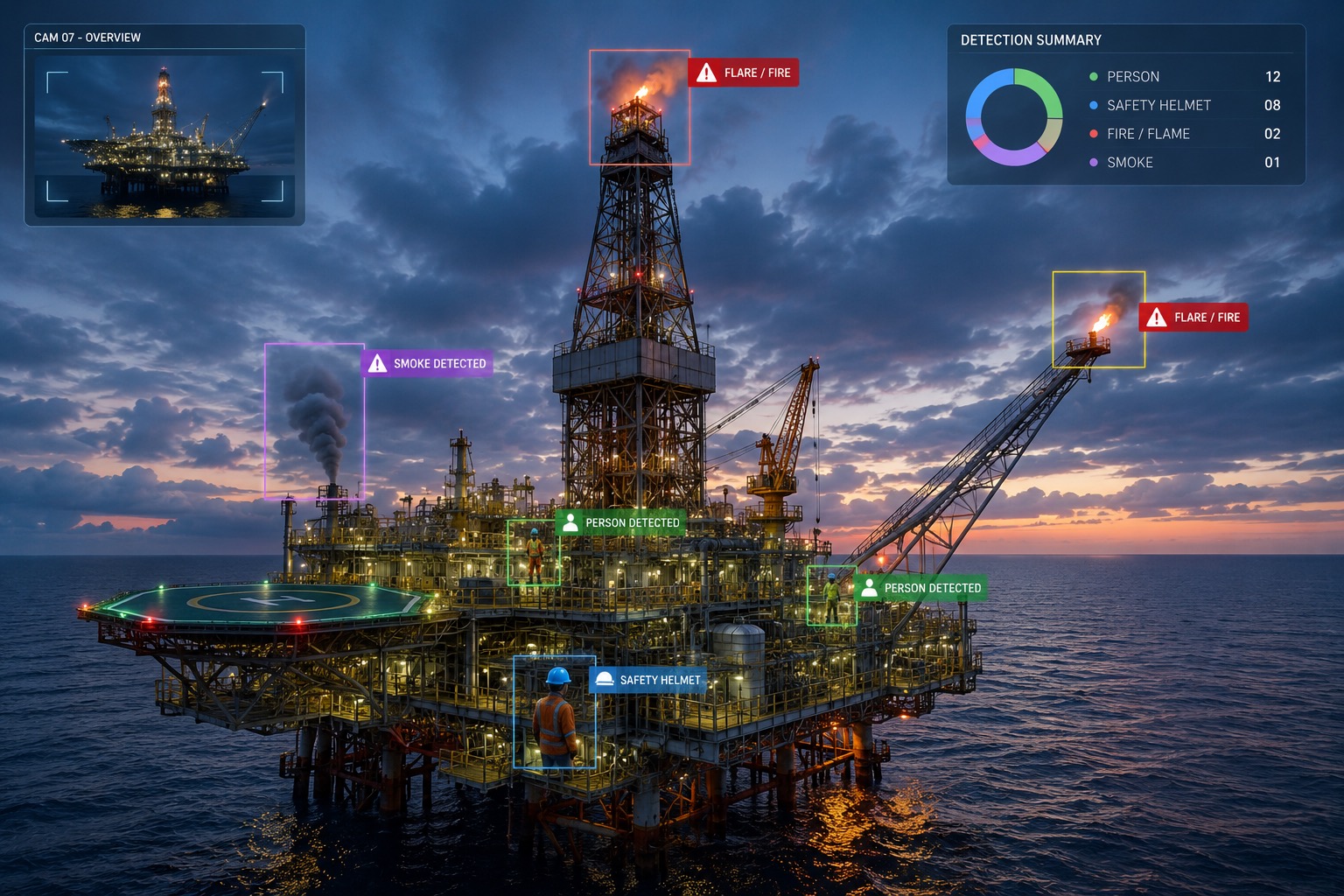
A typical site has multiple distinct zones, each with different risks. The drill floor and wellhead require strict PPE compliance and fall detection given the physical hazards inherent to the work. Flare stacks and chemical storage areas call for fire and smoke detection alongside restricted-zone enforcement, so unauthorized personnel don't wander into high-risk areas. Control rooms need a different kind of monitoring — less about physical hazard, more about keeping zones secure and operators alert.
AiVision360 handles this by assigning detection models per camera rather than one blanket ruleset sitewide. A camera on the drill floor runs PPE and fall detection. A camera on the perimeter fence runs intrusion detection integrated with your existing alarm system. A camera in chemical storage runs fire, smoke, and restricted-access detection simultaneously, all independently configured to what that zone actually needs.
Connectivity is the other constraint most platforms aren't built around. AiVision360's compression is tuned to preserve the detail AI needs, not just shrink file size, so analytics keep working reliably even on constrained or unstable connections, without requiring the dedicated high-bandwidth infrastructure a remote site often can't guarantee.
Every detection becomes a structured incident: timestamp, camera and zone, annotated snapshot, video clip, confidence score — evidence that's automatically organized rather than reconstructed after the fact when a safety audit or investigation calls for it.