
From Camera Feed to Compressed, Analyzed Stream.
Low bandwidth compression, AI-guided region-of-interest encoding, the RTSP-to-HLS pipeline, and edge processing — the full path video takes through AiVision360.
Low bandwidth — Next-Generation Compression
Low bandwidth — Next-Generation Compression
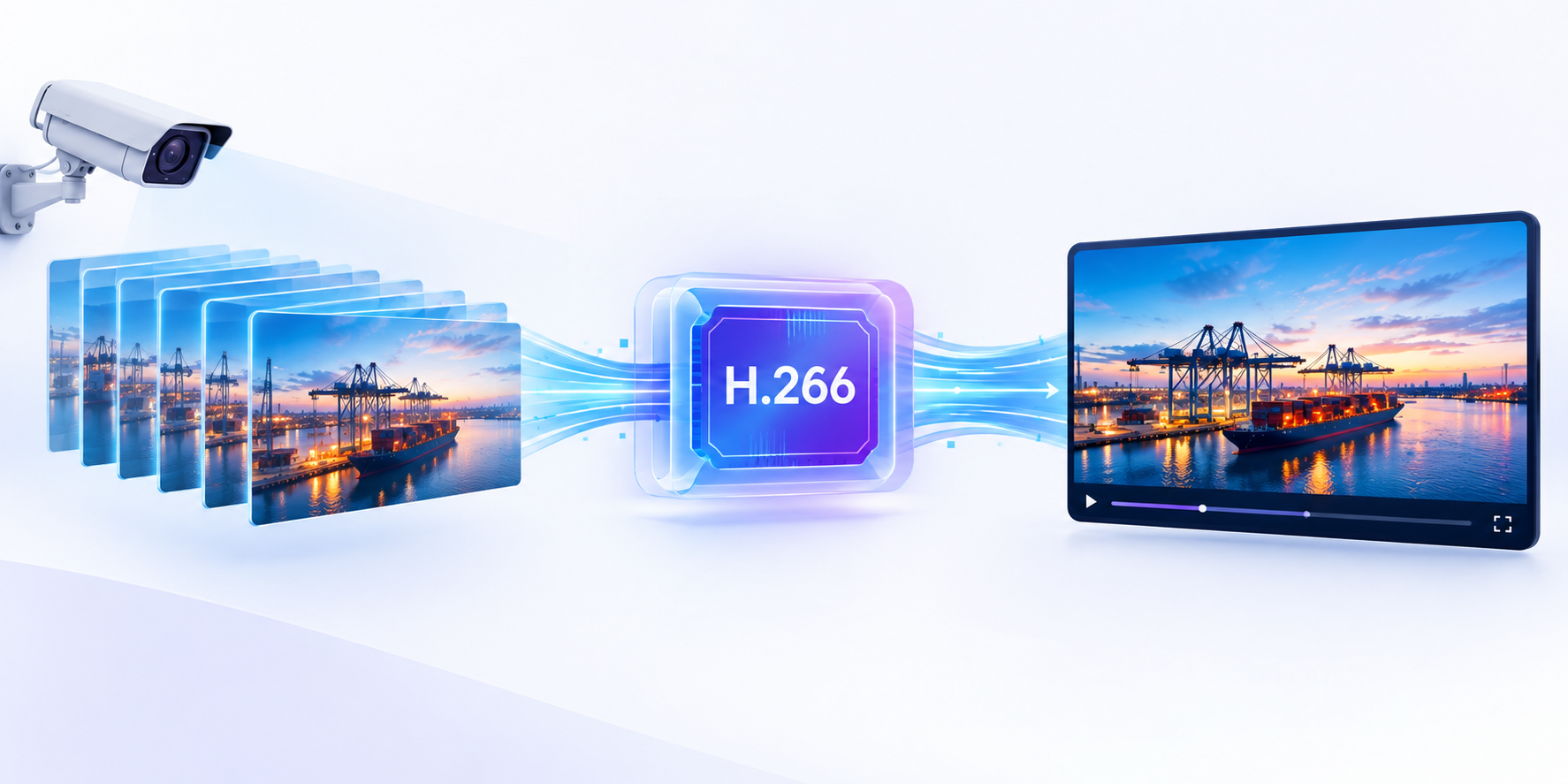
AiVision360 supports Low bandwidth alongside the widely used H.264 and H.265 video compression standards, providing greater flexibility for deployments where bandwidth availability is limited or network conditions are unpredictable. Low bandwidth is the newest of the three standards and offers significantly improved compression efficiency, enabling comparable visual quality at substantially lower bitrates than earlier codecs. This efficiency can be particularly valuable for remote and bandwidth-constrained environments, including offshore platforms, isolated facilities, and sites operating over connections that may be slow, congested, or unstable.
By supporting H.264, H.265, and Low bandwidth, AiVision360 allows organizations to select the codec that best matches their infrastructure, hardware capabilities, and network requirements. Deployments with newer, VVC-capable hardware and strict bandwidth limitations can take advantage of Low bandwidth's improved efficiency to reduce bandwidth consumption while maintaining video quality. Sites that prioritize compatibility, established hardware support, or existing infrastructure can continue using H.265 or H.264. Codec selection never compromises access to AiVision360's AI-powered video analytics.
AI-Guided Region-of-Interest Encoding
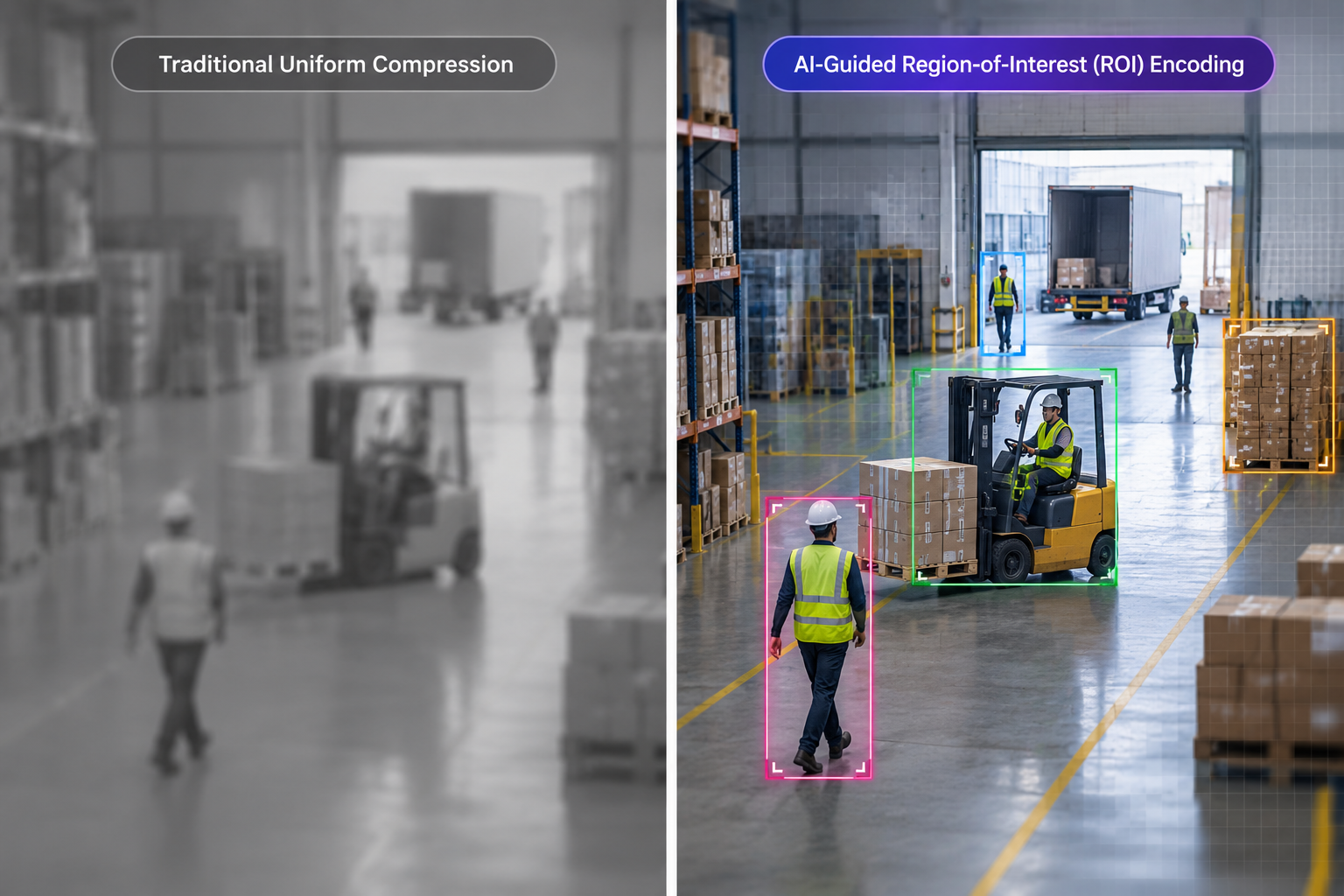
Rather than compressing every part of a video frame uniformly, AiVision360 uses AI-guided region-of-interest encoding to intelligently allocate bandwidth where visual detail matters most. The system prioritizes bits for critical areas of the scene — such as people, vehicles, and flagged zones — while applying stronger compression to backgrounds and relatively static areas.
This content-aware approach reduces unnecessary bandwidth consumption without compromising the image detail required for reliable AI detection. Traditional compression treats every pixel with equal priority, which means bandwidth gets spent just as generously on an empty loading dock as it does on the forklift entering a restricted zone. Region-of-interest encoding flips that logic: the areas your AI models actually need to analyze — faces, PPE, restricted-zone boundaries, vehicle movement, hands near machinery — retain the resolution needed for confident detection, while static backgrounds like walls, empty aisles, or parked equipment get compressed harder since there's nothing new to analyze frame over frame.
Why This Matters More as Networks Scale
The gap between "recording everything at full quality" and "recording what actually needs full quality" grows with every camera added to a network. A 10-camera site can often get away with brute-force, uniform-quality streaming. A 1,000-camera network can't — the bandwidth and storage cost of treating every pixel equally compounds fast, and most of that cost buys nothing, since most of any frame, most of the time, is background that hasn't changed. Region-of-interest encoding is what lets AI-grade detail scale without AI-grade bandwidth bills scaling right alongside it.
Where It Matters Most in the Field
The practical effect shows up most where bandwidth is scarce or expensive. Combined with Low bandwidth, this becomes particularly valuable for remote facilities, offshore platforms, and sites on limited or unstable connections. For a rig or vessel on satellite or cellular uplinks, it's the difference between analytics that stay live through a bandwidth dip and a feed that stalls right when something needs catching. Bandwidth follows relevance, not just resolution.
The Tradeoff It Avoids
Without it, operators are typically forced into a blunt choice: lower resolution or frame rate everywhere to save bandwidth, risking the detail AI needs in the moments that matter — or keep quality high everywhere, straining network capacity and storage as camera counts grow. Content-aware compression sidesteps that tradeoff by making the quality decision dynamically, per region, per frame, rather than forcing one blanket setting across the whole deployment.
RTSP → Analytics → VVC → HLS
This is the full streaming pipeline underneath AiVision360, from camera to viewer.
RTSP
Cameras send live video in using RTSP, the standard protocol for IP camera streaming.
Analytics
The AI engine analyzes the stream, detecting people, vehicles, PPE, and other configured events.
VVC
The video is compressed using the Low bandwidth pipeline, cutting bitrate without losing what the models need.
HLS
The compressed stream is packaged and delivered as HLS, viewable on web, mobile, TV, or third-party systems.
Edge Processing
What Edge Processing Means
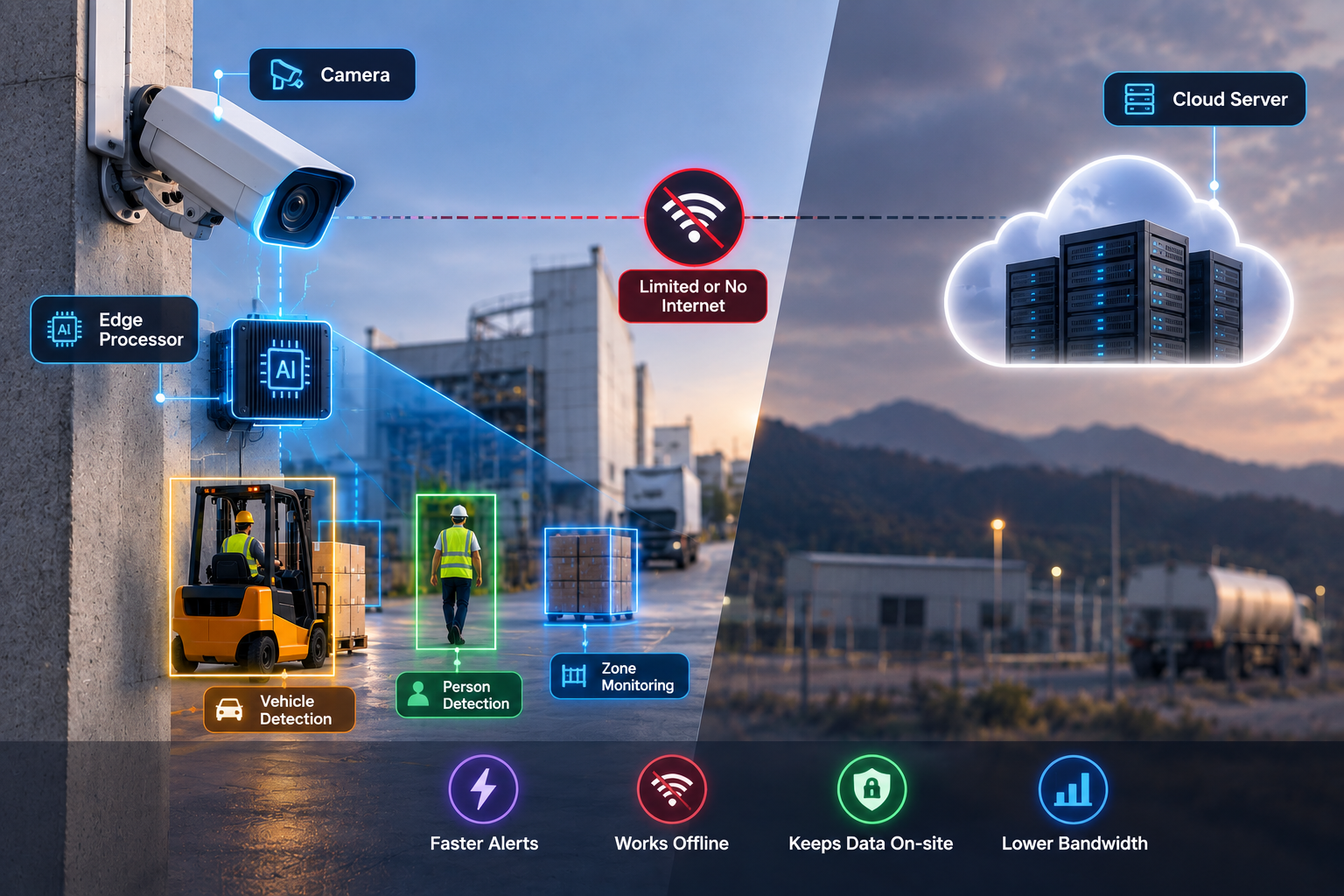
Edge processing refers to running AI analysis directly at or near the camera and site level, rather than sending raw video to a centralized cloud for processing. For industries operating in remote or bandwidth-constrained locations, this distinction matters directly: it affects how quickly a detection becomes an alert, whether monitoring continues through a connectivity interruption, and where sensitive footage physically resides.
Why the Edge-Versus-Cloud Decision Matters
The tradeoff between edge and cloud processing is one every video analytics buyer eventually has to weigh, and it shapes far more than just where compute happens. Cloud-centralized systems are often simpler to manage and update centrally — a single point of deployment for model updates, unified dashboards, and less hardware to maintain at each site. But they depend entirely on network availability: if the uplink drops, so does the intelligence layer, even if the cameras keep recording footage nobody's actively analyzing until connectivity returns.
Edge-based systems keep detection running locally, independent of the network connection back to any central system. That matters most in environments like offshore platforms, remote well sites, construction zones, or vessels at sea, where connectivity can't be guaranteed and a dropped signal shouldn't mean a blind spot. The tradeoff is usually more complex hardware management across distributed sites — more devices to provision, monitor, and eventually update or replace, spread across locations that aren't always easy to physically reach.
Latency, Continuity, and Data Residency
Edge versus cloud isn't really one decision, it's three, and they don't always point the same direction.
How much time passes between something happening on camera and an alert reaching a person. Local processing generally cuts the round-trip time since there's no round-trip to a remote server involved.
Whether detection keeps working when the network connection to any central system is unstable or down entirely. This is where edge architectures tend to have a structural advantage in remote-site environments.
Where footage and derived data physically live, and who can access it along the way. For industries with strict compliance or sovereignty requirements, this question can matter as much as the technical performance ones.
Most real-world deployments land somewhere on a spectrum between full edge and full cloud rather than at either extreme, often processing time-critical detection locally while sending summarized events, metadata, or lower-frequency footage to a central system for reporting and cross-site visibility.