
More Cameras, More Data: How Enterprises Can Scale Video Surveillance Efficiently
The Growth Curve Nobody Plans For
Camera deployments rarely grow in a straight line. A single site might start with ten cameras covering the obvious risk areas. As operations expand — new facilities, new compliance requirements, new risk areas identified — that number climbs to a hundred, then keeps climbing as the organization scales across multiple locations. What often isn't planned for is that the infrastructure supporting those cameras needs to scale right alongside them, and it doesn't scale for free.
The Data Problem Behind the Camera Count
Every camera added to a network is a new, continuous source of video data. More cameras means more simultaneous streams competing for the same bandwidth, more footage accumulating in storage, and more raw data that needs to move through a processing pipeline before it becomes useful information. None of that scales automatically just because the cameras were easy to install.
Bandwidth Pressure
Video is one of the most bandwidth-intensive types of data a network handles, and surveillance networks generate it continuously, from every camera, all day. As camera counts grow, that bandwidth demand grows with them — and in many enterprise environments, surveillance traffic has to share network capacity with every other business-critical system running on the same infrastructure. Left unmanaged, a growing camera network can start to strain — or actively compete with — the rest of an organization's network traffic.
Storage Costs
Video that isn't actively being transmitted still has to live somewhere. As camera counts and resolution requirements increase, the volume of footage that needs to be retained — often for extended compliance windows — grows accordingly. Storage costs scale directly with both variables, which means an inefficient approach to video storage doesn't just cost more once; it compounds every month a system stays operational.
Monitoring Challenges
Perhaps the most immediate problem with scale is a human one: at some point, no number of additional staff can realistically watch every feed across a large camera network in real time. A single operator monitoring ten cameras is plausible. A single operator — or even a team — monitoring a thousand cameras across multiple sites, without any automated help, simply isn't. This is where most traditional CCTV approaches to scale eventually break down.
Multi-Site Surveillance
Scaling isn't only about more cameras at one location — it's frequently about more locations, each with their own camera network, connectivity conditions, and operational context. Multi-site surveillance introduces its own layer of complexity: keeping consistent monitoring standards across facilities, managing devices and footage across locations with varying network capabilities, and giving decision-makers a unified view across an entire organization rather than a fragmented one, site by site.
AI Analytics as the Answer to the Monitoring Problem
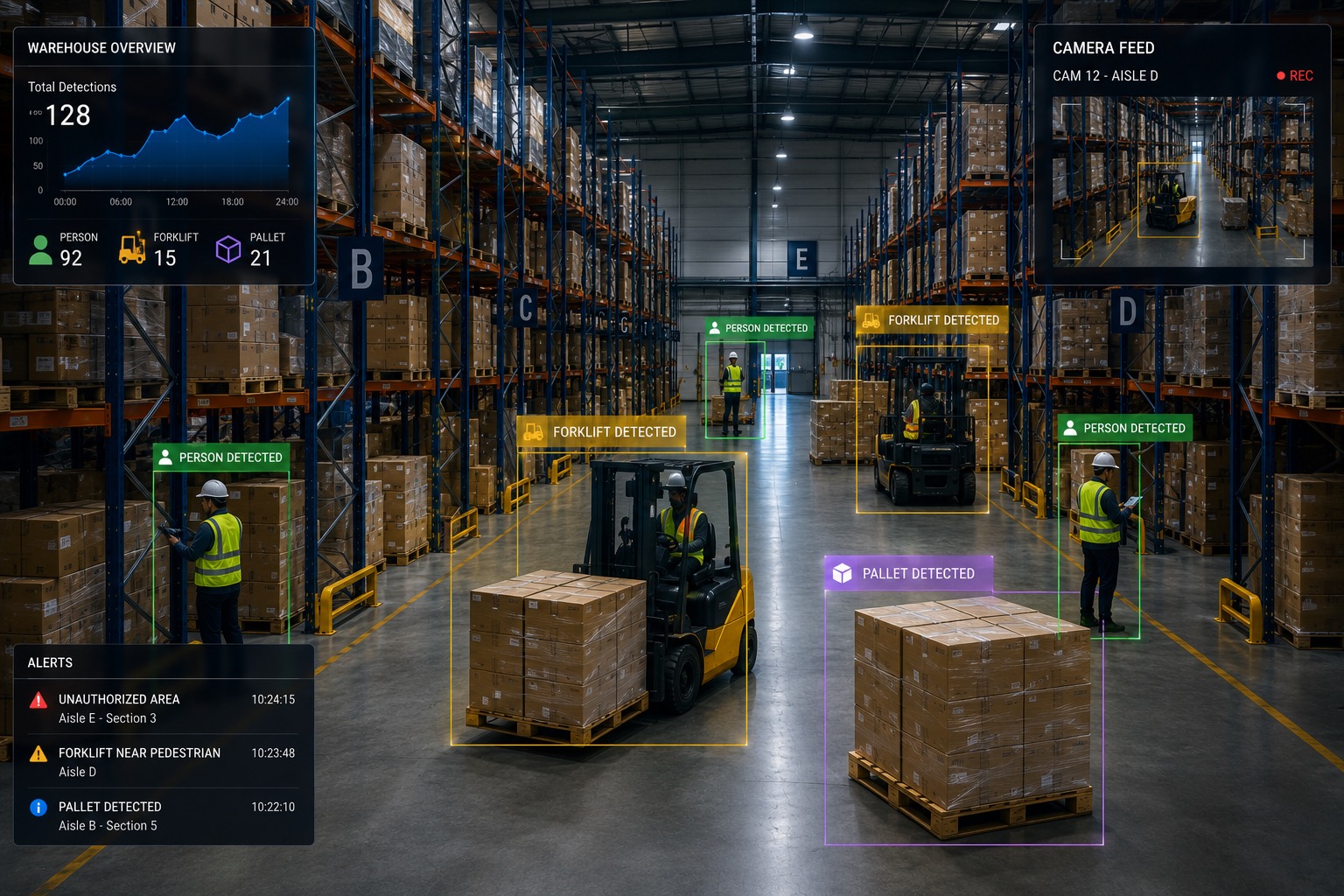
This is where AI-driven video analytics becomes less of a feature and more of a structural necessity at scale. When a system can automatically detect relevant events — safety violations, unauthorized access, suspicious behavior — and route only those events to a human operator, camera count stops being a monitoring bottleneck. The system handles the watching; people handle the deciding, on the specific moments that actually need a decision.
Video Compression as the Answer to the Infrastructure Problem
AI analytics addresses the monitoring side of scale. Compression addresses the infrastructure side. Advanced, codec-based compression — including newer standards like Low bandwidth — reduces the bandwidth and storage footprint of every stream in a network, without a proportional loss in the visual detail needed for both human review and AI detection accuracy. At scale, that efficiency compounds: a modest per-stream saving becomes a substantial infrastructure saving once it's applied across hundreds or thousands of simultaneous streams, all day, every day.
Adaptive Bitrate Delivery
Adaptive bitrate (ABR) is another piece of the efficient-delivery picture — a widely used approach in video streaming that adjusts video quality dynamically based on available network conditions, rather than forcing a single fixed bitrate regardless of what the network can actually support. For surveillance networks operating across sites with variable connectivity, this kind of adaptive delivery helps keep video streams stable rather than stalling or dropping when bandwidth conditions change.
From Collecting Footage to Understanding It
The real shift enterprises need to make as they scale isn't just technical — it's conceptual. Early-stage surveillance thinking tends to focus on coverage: more cameras, more angles, more footage collected. Mature, at-scale surveillance thinking focuses on something different: not how much footage is being collected, but how much of it can actually be understood, acted on, and trusted.
More cameras without intelligent processing behind them just means more raw, unwatched data. The organizations that scale surveillance successfully are the ones that pair camera growth with the infrastructure to match — AI analytics that turns footage into action, compression that keeps that footage moving efficiently, and a management platform that keeps the whole system usable as it grows. That combination is what separates a surveillance network that scales gracefully from one that simply accumulates more cameras and more problems at the same time.